Your First Long Box: A No-Nonsense Guide to Starting a Comic Collection on Any Budget
Every serious collector remembers their first real purchase. Not the comic your older sibling handed you, or the one you grabbed off a spinner rack as a kid — the first one you sought out deliberately, paid your own money for, and carried home like it meant something. That moment is the beginning of a collecting identity, and it's different for everyone.
The challenge for newcomers is that the comics world can feel intimidating from the outside. Decades of continuity, variant covers, grading scales, key issues — it's a lot. But here's the truth: building a great starter collection isn't complicated. It just requires a little direction. That's what this guide is for.
We've organized everything by genre and budget, because those two variables tell you more about where to start than anything else. Figure out what kind of stories you love, figure out what you can spend, and go from there.
Step One: Know What Kind of Reader You Are
Before you spend a dollar, ask yourself one honest question: are you collecting to read, collecting to invest, or both? There's no wrong answer, but the answer changes your strategy significantly.
Readers should prioritize story quality and completeness — full runs, trade paperbacks, and titles with strong creative legacies. Investors need to focus on key issues, first appearances, and print runs. Most people land somewhere in the middle, and that's a great place to be. You get the joy of the hobby plus the slow-burn satisfaction of watching certain books appreciate over time.
For the purposes of this guide, we're assuming you want both: books worth reading and books worth keeping.
Genre Breakdown: Where to Start Based on What You Love
If You're Into Superhero Action
Budget Pick (Under $25 total): Start with Marvel's Ultimate Spider-Man Vol. 1 by Brian Michael Bendis. It's a modern retelling of Peter Parker's origin, completely accessible to new readers, and trades are easy to find at local shops or online for a few bucks each. DC readers should grab the Batman: Year One trade — Frank Miller's definitive origin story, clean and self-contained.
Mid-Range Pick ($25–$100): Look for a run of All-Star Superman by Grant Morrison and Frank Quitely. Twelve issues, collected in one or two volumes, and widely considered the best Superman story ever told. On the Marvel side, Ed Brubaker's Captain America run (starting around issue #1 from 2005) introduced the Winter Soldier and is both critically acclaimed and increasingly collectible.
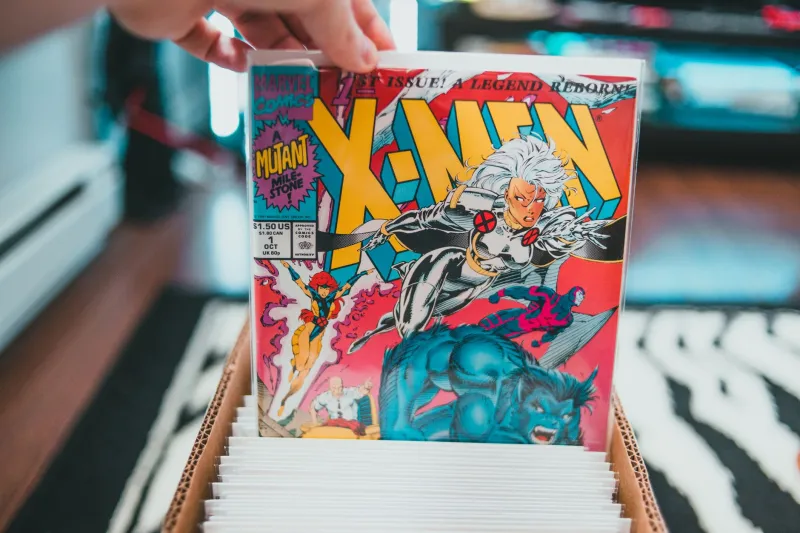
Collector's Pick ($100+): If you want a key issue with genuine long-term value, hunt down a mid-grade copy of Amazing Fantasy #15 — the first appearance of Spider-Man. Graded copies in the CGC 3.0–5.0 range are attainable for serious collectors and represent one of the hobby's foundational artifacts. Alternatively, House of X #1 (2019) by Jonathan Hickman is a modern key that reshaped X-Men continuity and is still reasonably priced in high grade.
If You Prefer Dark, Gritty Storytelling
Budget Pick: Saga by Brian K. Vaughan and Fiona Staples is available in affordable trade collections and is arguably the most important creator-owned comic of the last fifteen years. It's space opera meets domestic drama, and it hooks almost every reader within the first issue.
Mid-Range Pick: Preacher by Garth Ennis is a Texas-flavored road trip through religion, violence, and American mythology. The Vertigo imprint published some of the most daring comics of the 1990s, and Preacher is its crown jewel. Full run trades can be assembled for around $60–$80.
Collector's Pick: A CGC-graded copy of Watchmen #1 (1986) is a grail book for this genre. Near-mint raw copies are also worth owning just for the reading experience. Either way, it belongs in any serious collection.
If You Love Sci-Fi and Speculative Fiction
Budget Pick: East of West by Jonathan Hickman is a sprawling alternate-history sci-fi epic that rewards patient readers. Early trades are cheap and plentiful. For something shorter and self-contained, We3 by Grant Morrison is a three-issue heartbreaker about weaponized animals that reads in under an hour and stays with you for years.
Mid-Range Pick: Warren Ellis's Planetary is a love letter to pulp sci-fi and superhero mythology, running 27 issues with a complete, satisfying story. Trades run about $20–$30 each and are well worth the shelf space.
Collector's Pick: Early issues of 2000 AD featuring Judge Dredd, or key issues from the original Heavy Metal magazine run, are increasingly sought-after by collectors interested in the sci-fi side of comics history.
If You Want Something Outside the Superhero Lane
Budget Pick: Maus by Art Spiegelman is mandatory reading for anyone serious about the medium. Both volumes are available in a single affordable collection and represent one of the most important works in American literary history, comic or otherwise.
Mid-Range Pick: Persepolis by Marjane Satrapi is a memoir-style graphic novel about growing up in Iran during the Islamic Revolution. Accessible, emotionally rich, and a genuine conversation starter. From Hell by Alan Moore is another mid-range essential — a meticulous, obsessive retelling of the Jack the Ripper murders that doubles as a Victorian history lesson.
Collector's Pick: First editions of Maus in hardcover or early printings of Love and Rockets by the Hernandez Brothers carry real cultural weight and are worth tracking down at conventions or through reputable dealers.
Common Beginner Mistakes (And How to Skip Them)
Buying variants before you understand the market. Variant covers are seductive, but many of them carry artificial premiums that evaporate quickly. Learn the difference between a true first print and a retailer incentive variant before spending big.
Ignoring condition. A book with a spine roll, color-breaking creases, or moisture damage is worth a fraction of a clean copy. Even if you're buying to read, condition matters for long-term value. Handle books carefully, store them in bags and boards, and keep them out of direct sunlight.
Skipping your local comic shop. Yes, you can buy everything online. But your local shop is where you'll find knowledgeable staff, back issue bins full of surprises, and a community of collectors who've already made the mistakes you're trying to avoid. Support them. They're part of what makes this hobby worth having.
Trying to collect everything at once. Focus beats breadth every time. Pick one genre, one character, or one era and go deep before you go wide. A tight, well-curated collection tells a story. A pile of random issues just collects dust.
The Bottom Line
Your first long box doesn't need to be worth a fortune. It needs to be worth something to you — books you'd recommend to a friend, stories you'll reread, issues that represent the thing you love about this medium.
Start small. Start intentional. And don't be afraid to ask for help at your local shop. The comics community is one of the most welcoming fandoms out there, and most collectors remember exactly what it felt like to stand in front of a wall of back issues with no idea where to begin.
We all started somewhere. Might as well start here.